- gaoidea
- Jul 18, 2024
- 17 min read
Updated: Jan 19, 2025
CATALOG ONE: BRONZE 1: PHYSICAL EVIDENCES APPROVING AN INSCRIPTED BRONZE OF SACRIFICE ANIMAL WITH A SERVANT STANDING ON THE BACK AND HOLDING A PLATE LATE WEST ZHOU TO SPRING AND AUTUM PERIOD EXTREMELY RARE
这是一件具有铭文的青铜牺立人擎盘,在美国的一个小拍卖会发现并收藏。由于造型独特加之铭文,不敢轻易望断。一切以不可辩驳的物理特征来证明其真伪,而不是主观臆断。
随着对这件青铜器的物理观察,在器身及铭文上均清楚地发现完全相同而不可仿的物理特征,即结晶般的 ”锈泡套叠绿锈“和 ”密集珠状器皮绿锈“铁证。证明这是一件古青铜器真品,并且也证明铭文不是后刻,具有更重要意义。
“锈泡套叠绿锈”和“密集珠状器皮绿锈”已经作为判断青铜器真品的重要证据,而不是仅仅依靠专家的主观臆断。著名青铜专家指出 “锈泡套叠绿锈”具有不可仿制性,是判断青铜器真品的一个重要客观指标。并且,青铜专业把”锈泡套叠绿锈“作为法律判断真品的证据(见图25和26),而不是仅仅依靠专家的主观判断,可见其多重要。以上两种物理特征均在本藏品中可见,不是巧合。
目前所知的唯一一件出土战国青铜牺立人擎盘,以经作为山西博物院的镇馆之宝之一。该器较小,14.5 公分高,无铭文。作者收藏的牺立人擎盘要大许多, 34公分高,更重要是有铭文。二者的牺造型很接近。擎盘的纹饰完全不一样,本器盘中央为蟠龙纹和一圈夔龙纹,与出土的商周时期青铜盘的蟠龙纹很接近。山西博物院的这件盘上是镂空蟠虺纹,典型的战国时期的纹饰。
如果没有60年代山西出土的这件牺立人擎盘,单单从眼学看这件造型即铭文,极可能一直被当作了一件臆造品流散在民间而已。而它的客观流出海外的时间可能要早于山西出土器。正是因为青铜界把“锈泡套叠绿锈”和“密集珠状器皮绿锈”作为判断青铜器真品的重要客观证据,作者才有机会实事求是将这件罕见真品公布于世。
实事求是,能够一下子把握住这件非同一般青铜器,也算是一种缘分。自己对金属以及工艺很熟悉,有一种特殊亲和力或眼力吧, 得益于学医以前的经历以及从医以后到后来从事人工心脏和开发医疗产品的医学工程生涯,常年都在与金属打交道,这对判断铜器文物有相当大的帮助。
与其他类文物不同(比如瓷器),青铜器更具有物理特殊性,原因就在于它的金属属性。青铜器被深埋墓穴中相对无氧环境上千年,一方面不断地铜锈腐蚀,另一方面铜锈层被矿化形成凝固的铜锈结晶保护层使青铜器得以保存下来,是矛盾的对立统一。正是上千年的物理变化过程,会留下特有物理特征,而且无法复制,因为需要相同环境和千年的沉积。仿者都是急功近利者,他们会将做旧的仿品也埋在地下(充其量数年?)可以产生表面粉状腐蚀铜锈,但不可能产生上千年的物理结晶锈变化。也有用有机合成涂料涂在表面模仿铜锈,破绽明显,更不会形成锈泡套叠绿锈等的自然特征,局部高温一烧就立马气化消失(作者做过对比实验)。
最重要的意义是真品铜锈的特有物理特征能够定性,排除仿品。再结合眼学比如造型、纹饰、铭文进行断代,这是一种互补。由于历史原因,大多数铜器重器都无法查证确切出土证据,仅仅靠专家的眼学判断并不完善,容易出现错判。就像专家诊断病人一样,经验多逻辑性强则犯错的概率相对小,很多最终还得靠客观证据来定性确诊。文物判断何尝不是一个相同道理。
This is a bronze of sacrifice animal with a servant standing on the back and holding a plate, found in a small auction in U.S.. All judgements about the real or fake are based on the physical evidences that are solid and unduplicatable, not by person's intentional judgement.
The solid physical evidences, the "green rust shown as large rust bubble wrapping small rust bubble or bead" and "green rust shown as paint skin with intensive beads", are identified under magnifier in which the same physical features are found not only on the bodies but also on the inscriptions. The evidences demonstrate that the inscriptions are original (not added later) and extremely important.
The "green rust shown as a large rust bubble wrapping small rust bubble or bead" and "green rust shown as paint skin with intensive beads" are used as the solid evidences to identify a real bronze, not only just relying on personal judgement by experts. Especially, the famous expert pointed out that the "green rust shown as a large rust bubble wrapping small rust bubble or bead" is NOT duplicatable physically and it is a solid physical evidence to identify the real Chinese ancient bronzes. More important, the "green rust shown as large rust bubble wrapping small rust bubble or bead" is used as the judicial evidence for identifying the real bronzes by the official judicial system and it is such important . It is not surprised that the important physical features described above are found in the piece I collected.
A famous Chinese treasure, the bronze of a sacrifice animal with a servant standing on the back and holding a plate unearthed in 1959, is in Shanxi Museum. It is relatively small (14.5 cm tall) and no inscriptions on it. The piece I collected is much larger (34.5cm tall) and more important there are inscriptions on it. Basically both sacrifice animal are very similar. The motif on both plates are significant different. The "Pan dragon" in middle of the plate of mine with "Kui dragon" circled around is very similar to unearthed bronze plates belonging to Shang and Zhou dynasties.
This piece could have been treating as a fake or fabricate if judged only by eyesight without the reference piece in Shanxi Museum. Very possibly this piece I collected could be unearthed and brought out to west countries before 1959 when the similar piece unearthed in Shanxi Provence. It is my pleasure to have the great chance to bring this extremely rare and real piece to the world based on the solid and unduplicatable physical evidences.
Honestly it was very destined to have this bronze piece when I suddenly saw it. I am very familiar with metals and techniques because of my over 40 years experiences in dealing with metals before medical school and during my professional carriers that I focused on the development of artificial heart and medical devices for patients. That is how I gained a lot of special affinity or eyesight to metals and big benefit for me to identify bronze pieces.
Unlike other antiques (such as ceramics), the bronzes are shown more metal physical features during the process of metal rust while they were berried deeply without oxygen in toms for thousands years, on the other hand, also shown the unit of opposites of contradictory in which a protective layer over the bronze is formed with solid crystal features through out the process of mineralization. So they are survived. The physical features after thousands years are definitely generated and no way to be duplicated because the berried condition and the process over thousands years. All copiers who seek for short-term benefit may berry the bronzes under the ground for a limited time (few years maximum?) to generate powder-like rust on the surfaces but no way to duplicate the physical features discussed above. Copier also could make fake rust using organic compounds to the surfaces, but too many flaws that are easily to be pointed out. The final way to demonstrate the fake compound rust (if necessary for serious piece as I did) is to fire on a tiny spot or a piece and the fake compound will disappear as gas style in seconds.
The significance for the physical evidences discussed above is the qualitative methodology that makes sure to exclude any fake piece. Thereafter combining with the judgement by eyesight, such as the pattern, style, motifs, materials, craftmanship and inscriptions etc., experts can determine which dynasty the pieces belong to. This a combining methodologies, but not just judged by expert's eyesight because mistakes are easily to happen. The same things happen to doctors who try to diagnose difficult patients, the more experiences and logical analysis they have, the less chance to make mistakes. However the final diagnoses are most likely based on the physical evidences in majority cases. We all know that many of the important Chinese bronzes in museums are lack of solid documents to tell exactly where and when these bronzes were unearthed due to the historical reasons, including the piece I collected.

图一 34 cm tall

图二


图三 参考图 山西博物院镇馆之宝之一 通高 14.4 公分 (破损修复后)
Chinese treasure in Shanxi Museum, 14.4 cm tall

图四 参考图 山西博物院 牺立人擎盘, 盘直径 14公分, 镂空蟠虺纹
Plate 14 cm in diameter, motif of "Pan Hui", Shanxi Museum

图五 盘直径 21.7公分。 本藏品与山西博物院藏品的最大区别是盘中的纹饰。本盘中央为蟠龙纹,然后围绕一圈交体夔龙纹。最重要的是外圈开窗有近三十八字铭文。也许,这是目前唯一一件中央有这种蟠龙纹 和铭文 的立人擎盘,非常罕见。蟠龙纹和夔龙纹代表皇权至高无上。
Plate 21.7cm in diameter, The most differences between two plates above are the motif of "Pan dragon" and inscriptions shown on the plate I collected. Perhaps this is the only one that has such motif of "Pan dragon" with inscriptions, extremely rare. "Pan dragon" and "Kui dragon" mean the absolutely highest power of Emperor.

图六 参考图 山西博物院 Shanxi Museum

图七

图八 前额高发夹造型与山西博物院的这件不一样,但馆藏春秋青铜盘足有高发夹造型。
High hairgrip forehead style, different from the piece in Shanxi Museum. The same high hairgrip forehead style can be found from a museum's item (Fig. 9). that is from Spring and Autumn period.

图九 参考图 前额高发夹造型 馆藏春秋青铜大盘立足局部
Reference, hairgrip style forehead, Museum item, the foot of bronze plate, Spring and Autumn period.

图十 高发夹造型

图十一 铸造相当精致。蟠龙纹与馆藏商周时期青铜盘中的蟠龙纹很相似,每一件都大同小异,各有特点。龙身以这种菱形间三角形纹居多。一圈夔龙纹环绕,以交龙的形式比较独特。夔龙头部造型也符合商周春秋时期(见图二十)。
这件盘是采用范铸工艺铸造而成,可以看到范铸工艺痕迹。铭文如此圆润,也是通过范铸工艺完成的。如果是后刻上的,一定会留下錾刻痕迹。毫无疑问,铭文和盘是同时铸造完成的。
Very detailed cast. The motif of "Pan dragon" is very similar to the bronze plates of Shang and Zhou period in Museums. Each one is a little different with its own taste. The pattern of the diamond and triangle on the dragon's body are shown more in these bronze plates. The "Kui dragon" surrounding the "Pan dragon" is typical, but the tangling style is unique. the details of the head of "Kui dragon" is very similar to the literatures (see Fig. 21).
This plate is made by casting and some traces of cast can be seen (not shown here), The inscriptions are so smooth and curved style, absolutely made by casting with the plate at the same time. The carved traces will be seen if the inscriptions were added later.

图十二 参考图 菱形间三角形蟠龙身 ”Pan dragon“ with the body of diamonds and triangles, Shang Dynasty, Freer Gallery

图十三 参考图 图十四 小屯M18墓出土
两件均河南出土器 商代 菱形间三角形蟠龙身 Both unearthed plates in Henan Provence, Shang Dynasty. "Pan dragon" with the body of diamonds and triangles.

图 十五 参考图 苏富比拍卖品,青铜盘,晚商,菱形间三角形蟠龙身。
Reference, auction by Sotheby's, late Shang Dynasty. "Pan dragon" with the body of diamonds and triangles

图十六 参考图 出土铜盘 温岭博物馆藏, 商代。 菱形间三角形蟠龙身
Reference, unearthed plate, Shang Dynasty, Wenlin Museum. ”Pan dragon" with the body of diamonds and triangles.

图十七 参考图 菱形间三角形蟠龙身
Reference, West Zhou Dynasty, Tenri University, Sankokan Museum, Japan. "Pan dragon" with the body of diamond and triangles.

图十八 参考图 晚商, 台北故宫博物馆
Reference, late Shang Dynasty, Summer Palace Museum, Taibei

图十九 参考图 西周末春秋早期,临汾博物馆
Reference. Late Zhou or early Spring and Autumn period, Linfen Museum

图二十 参考图 大英博物馆 The Great British Museum

图二十一 The "Kui dragon" (left) is so similar to the one with the red mark in the public literature about the "Kui dragon" from Shang, Zhou. So amazing.
"锈泡套叠绿锈“ 和 ”密集珠状漆皮绿锈“
下面将重点揭示这件立人擎盘的物理证据 ”锈泡套叠绿锈“和”密集珠状器皮锈“。这种青铜器上的物理特征是青铜专家团队通过大量博物馆出土青铜器真品研究后得出的科学结论。相比其他类文物(如瓷器等),青铜器更具特性,是因为它的铜金属属性和客观表达。被深埋地下无氧状态经历上千年的铜锈及矿化过程所留下的客观物理特征,而这些具有结晶化的铜锈特征仿者无法复制,因为需要环境和上千年的岁月。专家明确指出,“锈泡锈目前无法物理复制,古而能当作真品锈的典型指标特征”。
非常重要的一点,锈泡套叠绿锈和密集珠状器皮绿锈已被青铜专业界作为司法鉴定的物理证据(见图二十一),尤其锈泡套叠绿锈排在判断真品铜锈第一位,无可辩驳的证据。
“GREEN RUST SHOWN AS A SMALL RUST BUBBLE OR BEAD WRAPPED UP BY A LARGE RUST BUBBLE" and "GREEN RUST SHOWN AS PAINT SKIN WITH INTENSIVE BEADS"
Now I am focusing on the physical evidences of "green rust shown as small rust bubble or bead wrapped up by a large rust bubble" and "green rust shown as paint skin with intensive
beads". The scientific conclusion of the physical evidences above was made by experts after they did a serious researches on many unearthed bronzes in museums. Comparing with other antiques such as ceramics, bronze is more unique showing its metal features. The physical features are remained after the process of the mineralization of bronze rust under the deep ground for over thousands years. Copiers have no way to duplicate these crystalized physical features because of the conditions and over thousands years period. The expert points out clearly that the "green rust shown as rust bubble" cannot be duplicated physically so far and it can be used as a typical feature of the real rust of bronze.
Another key point of the "green rust shown as large rust bubble surrounding small rust bubble or bead" and "green rust shown as paint skin with intensive beads" is that these physical evidences are used officially as the judicial identification of real bronzes (see Fig.).

图二十二 参考文献 来自百度 Ai 回答。实际上,这是著名青铜鉴定专家刘雄博士的团队经过对大量中国博物馆青铜器藏品研究得出的结论。结论中清楚指出锈泡锈目前无法物理仿制,故能当作真品锈的典型指标特征。
Fig. 22 Reference, Ai answer from Baidu. Actually it comes from Dr. Liu, the famous expert of bronze, who made this conclusion after serious researches on the important bronzes in museums in China. Dr. Liu pointed out clearly that the "large rust bubble surrounding small rust bubble or beads" cannot be duplicated physically so far and it can be used as a typical feature of the real rust.

图二十三 参考图 来自著名青铜鉴定专家刘雄博士
Reference, real sample of the "large rust bubble surrounding small rust bubble or bead" described by Dr. Liu Xiong, the famous expert of bronze,

图二十四 参考图 锈泡套叠绿锈 来自青铜鉴定专家刘雄博士
Reference. the large rust bubble surrounding small rust bubble, from Dr. Liu Xiong


图二十五 参考图 密集珠状漆皮绿锈 图和解读均来自著名青铜鉴定家刘雄博士
Fig. 25 and description are about the sample of the "green rust shown as paint skin with intensive beads", from Dr. Liu Xiong

图二十六 参考文献 陕西文化艺术品司法鉴定中心属于官方机构,青铜鉴定由顶级专家吴镇烽领衔。他们把锈泡套叠绿锈作为专业认可的判断真品铜锈的第一首选。所谓司法鉴定,就得依靠可信和同业认可的证据,才能作为法律依据。而不是仅仅依靠专家的主观意识作最终判断,否则非常容易出错,这不是开玩笑。
Reference literatures. The official center of judicial identifications for culture and art of Shanxi. The top expert, Mr. Wu Zhen-Xiong, who leading the identification of bronzes chooses the "green rust shown as large rust bubble surrounding small rust bubble or bead" as the number one to identify the real bronze rust. The so-called judicial identification means only the reliable physical evidences that are authorized by the professional society are used, instead of just personal judgement by experts (It is easy to make mistakes and it is not a joke).

图二十七 参考文献同样来自该鉴定中心。 这是一次利用青铜物理证据“锈泡套叠绿锈”作为法律判断。在部分判断为青铜器文物中正是采用这个物理证据。可见青铜物理证据多么重要,它是客观存在,不是主观意识能够代替的。
Reference literature from the same center above. This is a very typical judicial identification in a smuggling case that there were about 100 pieces of bronzes. Part of them were identified as the real bronzes based on the physical evidence of "green rust shown as large rust bubble surrounding small rust bubble or bead". How important the physical evidence is for identification. It physically exits in nature and could not be substituted by personal's judgement.

图二十八 青铜觚局部 晚商 大英博物馆(本人拍摄)株状铜锈结晶如宝石般,非常神奇的几千年铜锈矿化结晶。
下面将显示来自本藏品的物理特征: 锈泡套叠绿锈和密集珠状器皮绿锈
Followings shown the physical features of " green rust shown as large rust bubble surrounding small rust bubble or bead" and "green rust shown as paint skin with intensive beads" from the piece I collected

图二十九 本藏品 。 这是在高倍镜下铜锈物理特征。正如专家证明的一样,清楚显“示锈泡套叠绿锈”。有的大锈泡套小锈泡,有的大锈泡套珠状或针状晶体锈。周围也布满“密集珠状器皮锈”。可以肯定,这些具有特征性的晶体结构来自千年以上铜锈的矿化结果,人为是不可能做出这种结构。
The piece I collected. As the same of physical evidences pointed out by experts, the "green rust shown as large rust bubble wrapping small rust bubble or bead" and the "green rust shown as paint skin with intensive beads" . For sure, these typical structures of crystal rust are from the process of mineralization of rust for over thousand years. There is no way f or copiers to duplicate such physical and crystal structures.

图三十 锈泡有的晶体壁厚,有的晶体壁较薄。some crystal rust bubbles are thinner and some crystal rust bubbles are thicker.

图三十 晶体大锈泡套晶体小锈泡。周围布满翠蓝翠绿晶体般的密集珠状器皮锈。
The crystalized large rust bubble surrounding small crystal bubble. The turquoise paint skins with intensive crystal beads.
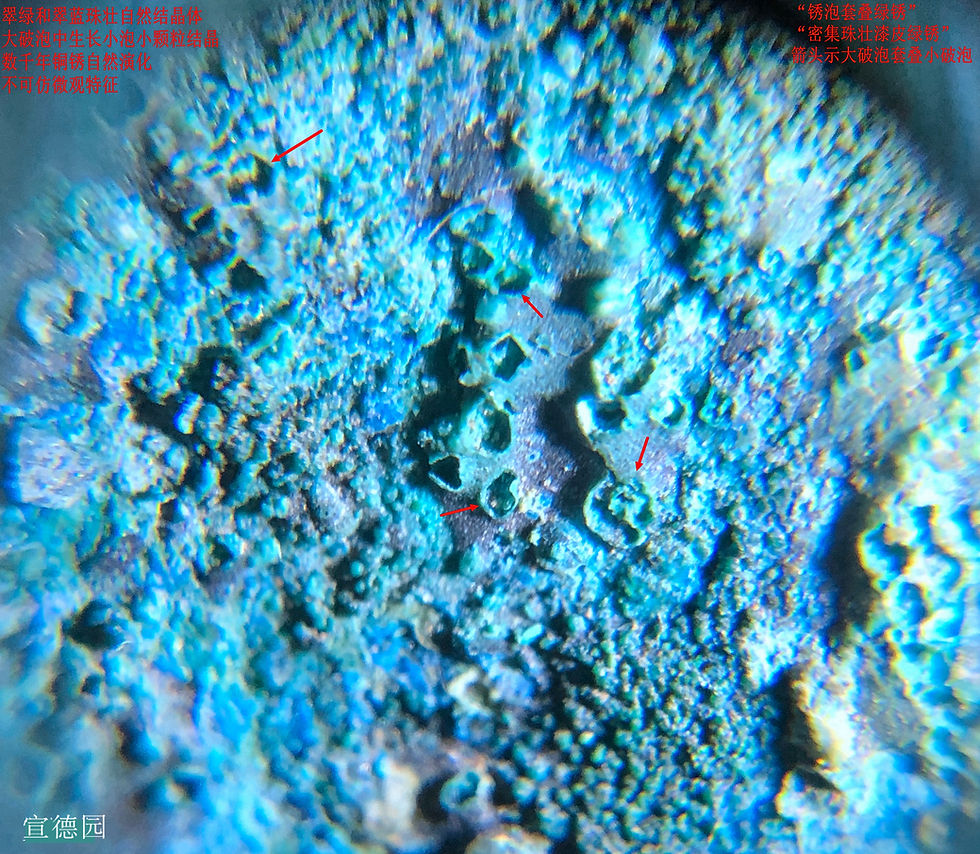
图三十一 这张图充分显示锈泡套叠和密集珠状结晶体,有些成翠绿结晶,有些成翠蓝结晶。人为是绝对无法复制这种千年以上铜锈矿化的结晶结构。
The crystalized structures of rust bubbles and intensive beads are clearly seen here. some are crystal blue and some are crystal green. These crystalized physical structures come from the process of mineralization of bronze rust over thousand years and there is no way for copiers duplicate them.

图三十二 锈泡套叠绿锈和密集珠状器皮锈, 矿化结晶体。
very typical "green rust shown as large rust bubble surrounding small rust bubble or bead" and "green rust shown as paint skin with intensive beads" . All crystalized!

图三十三

图三十四 典型的锈泡它的绿锈和密集珠状器皮绿锈,形成一层结实的铜锈结晶体保护层 ,很神奇的物理变化特征。
Very typical "green rust shown as large rust bubble surrounding small rust bubble or bead" and "green rust shown as paint skin with intensive beads", and look like a very solid crystal layer over the surfaces, such amazing physical features of the bronze rusts.

图三十五 铭文祖字中参照可见锈泡套叠绿锈和密集珠状器皮绿锈,证明铭文是与铜器同时铸造完成的,有非常重要意义。
The "green rust shown as large rust bubble surrounding small rust bubble or bead" and "green rust shown as paint skin with intensive bead" are also clearly seen in one of the inscriptions. It demonstrates that the inscriptions were made at the same time with the bronze itself and is very important.

图三十六 The "green rust shown as large rust bubble surrounding small rust bubble or bead" and "green rust shown as paint skin with intensive beads" war seen in another inscription.

图三十七 另外一个铭文中, 也清楚看到锈泡锈和密集珠状器皮绿锈。
The typical rust bubble and green rust shown as paint skin with intensive crystal beads are seen in another inscription.

图三十八 重要揭示。 这是作者从一件青铜仿品上取下的一小块所谓铜锈样品(这件仿品能蒙蔽很多人, 如果仅仅靠眼力)。作者对其进行高温火焰喷烧实验(包括在自己的藏品上的很小局部,不得于而为之, 不提倡)。火焰喷烧后,这块有机合成物的假铜锈块即刻气化消失得干干净净,留下掺和物的细砂颗粒。真正铜锈结晶不会雾化消失。
This is a small piece of fake rust (left) from a fake bronze. The fake piece was immediately disappeared as the smoke gas style in seconds when I put fire on it except the sand left
(right photo). The real crystal rust will not disappear by fire test.
真品铜锈小结
从图二十九至图三十七, 非常清楚的铜锈物理证据 “锈泡套叠绿锈”和 “密集珠状器皮绿锈” 展现在作者的这件青铜立人擎盘上,而且在铭文中也同样展现相同的物理特征,作为真品的判断提供有力的不可仿证据。正是有这些客观不可仿的物理证据,作者才敢断定是一件罕见青铜立人擎盘真品。根据所有的特征综合判断。它的年代不会晚于春秋,极可能属于西周。
Brief Summary About The Real Rust
The physical evidences of "green rust shown as large rust bubble surrounding small rust bubble or bead" and "green rust shown as paint skin with intensive beads" are clearly shown in Fig. 29 to 37 in the piece I collected, including the same evidences in inscriptions. The evidences above support the judgement of a real bronze. This is an extremely rare and real bronze of sacrifice animal with a servant standing on the back and holding a plate from around Spring and Autumn period, maybe West Zhou.

图三十九 铭文大约三十八字,少部分字迹模糊不清,放大镜下仍可看出痕迹,如果专业清理后应该可以清楚显示(目前保持原状}。大概有“宣公” ”亡“ “月” “用” “祖” “又” “木” “赐” “白”“不” "周?” 等字样。作者尚无能力解读,需要青铜铭文专家来解读,才能得知铭文的完整信息。字体弯曲圆润,于山东大学的出土春秋青铜盘的铭文风格颇相似。
There are about 38 inscriptions in which the small part of them is not clear but still being seen roughly under magnifier. It will be seen clearly if cleaned up by professionals (I want to keel them original). The inscriptions are very smooth and curved and the style is very similar to the inscriptions on the bronze plate unearthed from Spring and Autumn period in Shandong University.

图四十 山东大学藏出土青铜盘铭文
Reference. Inscriptions on the bronze plate unearthed, Spring and Autumn Period, Shandong University

图四十一

图四十二
总结
作者很荣幸将这件非常罕见的青铜器真品公布于世。它是一件青铜立人擎盘,而且有铭文。所有物理证据都证明是一件真品。综合典型的蟠龙纹、夔龙纹。立人高发卡造型、牺造型及铭文特点,尤其是蟠龙纹造型及其龙身菱形间三角行几何纹不在战国青铜盘上发现,这件青铜立人擎盘应该不晚于春秋,或可能西周。它的铭文可能揭示更多信息。总之,这是一件真品毫无疑问,作者只不过是遵循了实事求是的原则。作者非常庆幸发现并将其收藏,如果任其被当作仿品不被保护,可能会在自生自灭中损毁或消失。同时,作者也希望这件藏品能够为山西博物院的那件镇馆之宝作为互补,铭文或许能够解读牺立人擎盘的用途。
SUMMARY
It is my pleasure to show this extremely rare real bronze to the world. This is a bronze of sacrifice animal with a servant standing on the back and holding a plate and also there are inscriptions on it. All the physical evidences demonstrate that it is a real bronze. This piece is possibly from Spring and Autumn period or West Zhou based on the typical "Pan dragon", “Kui dragon", high hair pin style and inscriptions style, more particularly the "Pan dragon" with the typical pattern of diamond and triangle on the body didn't see in bronze plates from Warring States period. The inscriptions may reveal more information in the near future. No doubt about it is a real piece and I just follow the role to seek truth from facts. It is so lucky for me to have the chance to see and collect it, otherwise it could be to emerge and perish on its own, very possibly to be damaged or disappeared forever if treated as a fake. Hopefully this piece I collected might benefit for the piece, the Chinese treasure in Shanxi Museum, if the inscriptions can provide more detail information about its purpose of use.
下一篇将继续 next new one is on the way

